Thursday, November 05, 2009

1965 Rambler Ambassador 990 Crosscountry Wagon

About a week ago, I went to check out a 1965 Rambler wagon. At the time, I was still pondering some kind of cool daily driver to allow me to park my Pontiac Formula, saving her from another brutal winter. I wasn't looking to spend a lot of money, but at the same time, expected a lot for what I was willing to spend. An ad for an AMC wagon caught my eye in the local Auto/RV Trader - $3,500 or best offer. Within a few days, I ventured a few hours north to check it out.

The whole idea was to have a cool daily driver while I got my Camaro roadworthy for next year, and allowed me to park my Pontiac, in preparation of it's own restoration in the near future. As the possibilities, and more importantly, realities, raced through my head, I managed to talk myself outta the car.

It wasn't that it wasn't a sweet ride, it's simply the fact that I didn't need such a ride at this time. Had my Camaro been back on the road, I would have bought this car in a heatbeat! Instead, I ran the numbers, and the seriously impacted the likelyhood of the Camaro getting finished by next year. I was gonna use a 0% courtesy check, then pay payments of around $300 for the next several months until the car was paid for. Then, I had to consider any maintenance could run me a few $100's to repair. Ad that up, and you have $500-$600 that could have been put towards the Camaro, as opposed to a 45 year old daily driver.

The car was about as perfect condition you'll find in an unrestored state, when the car has seen a life of being used. The paint was faded, though not rusty, as proof the car came from down south in recent years. The only serious rust is in the pictures below: Passenger side floor pan corner, inner fender near the passenger hood hinge, a small spot on the firewall, and some minor surface rust with a small hole from where the car apparently hit something on the passenger side. Other repairs required were: new carpet, seats needed reupholstered, new dash pad, and a left rear tail light lens.

With those repairs, some black primer, and lower this baby to the ground, and you have a ride that would attract quite the mob scene at car shows! Powered by a 287 w/3 on the tree, the car came equipped from factory with A/C, though a few lines were missing and the owner stated he never had the system charged. If only the timing would have been better, this would have been the unique/different ride I was looking for as a project later on down the road. Instead, I enjoyed my road trip and chat with a fellow gearhead, while learning a thing or two about AMC's.


Tuesday, October 13, 2009

She will rise from the ashes in 2010

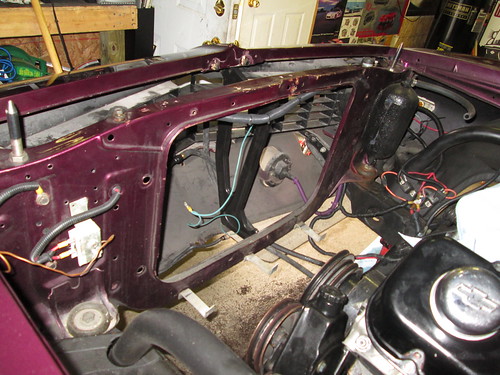
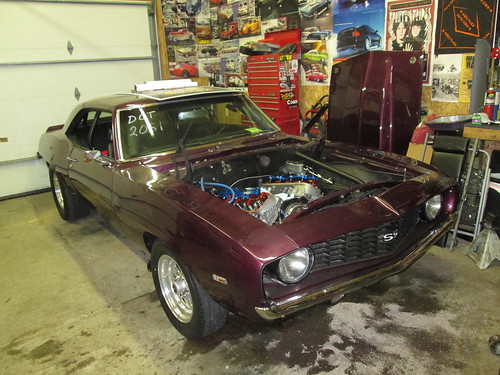
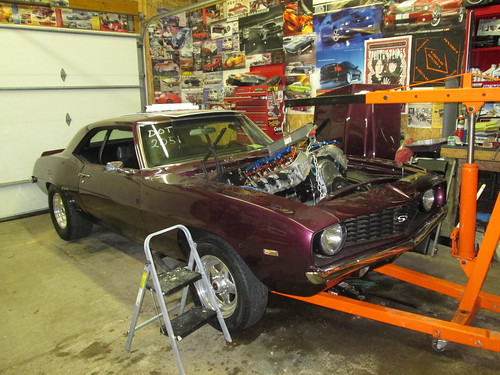
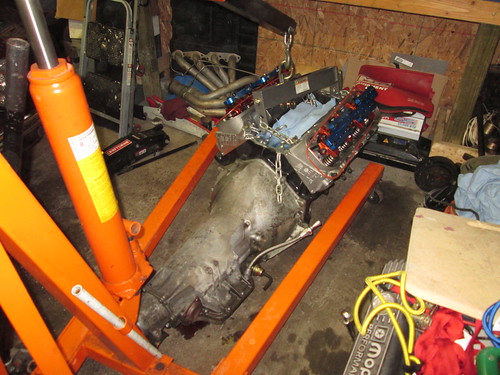
2010 looks to be the year my Camaro will once again see the road. Hard to believe it has been nearly a decade since I pulled her off the road. The plan was to have a 12 point roll cage installed, rebuild the engine, and be good to go in a few years...tops! Well, a few years quickly turn into nearly 10. A new garage, destined for my Camaro, soon becomes a parking spot for my fiancee (soon to be wife). In other words, the realities of life took over, and the Camaro became a much lower priority.

Now, with my fiancee with a full time teaching position, and myself just getting my 2 year anniversary raise, we are setting much better off. At the end of each month, I will now have extra money, money in which I can begin to purchase the parts I need. Yesterday, I ordered up a new set of tail lights. I cracked my old set when removing the battery kill switch. I went with the RS tail lights this time, as I've always liked the look of them.

I have assembled a complete list of "gotta have its" to get the Camaro back on the road. In order to fast track the reassembly, I have had to put a few things on hold, such as a beefier rearend able to handle all the new found power. I'll hold off on a sticky set of tires, and other than a few tire smoke shows, I should be able to milk another year outta my 12 bolt. The steering will be upgraded with an AGR box, and the brakes with an undetermined kit that will increase the stopping power. Aside from a front windshield, most all other parts needed are engine related. A good number of the engine parts I will hold off on until getting the engine to my machine shop, likely early next spring. If all goes as planned, a June-July appearance should be obtainable. I'm gonna keep my fingers crossed, by this time around, it's more than just a pipe dream.

Expect a greater number of posts in the coming months. Many will simply be updates on what parts I've ordered. By spring, expect more pictures and actual progress on putting the car back together. I have yet to decide whether I will assemble the car down at my parents house, as it currently resides at my grandma's next door to them. Or, the other option is trailering the car back up here and assembling it here. There are options with both locations, and I'm sure it'll end up being a partial assembly at one location, and the finishing touches at the other. Stay tuned!

Friday, October 02, 2009

Test Drive: 2009 Challenger R/T

Yesterday, my fiancee and I took a trip up to the local Dodge dealership. The lease on her Dakota is about up, and we wanted to look at our options. Personally, I've been pushing for a Challenger, though she's always been a truck drivin' girl and I knew the deck was seriously stacked against me. Regardless, I was deadset on at least taking one out for a spin, to see what these new modern muscle cars were all about.

I let Melissa drive first, as it was after all her who was looking for a vehicle. After we went for a nice cruise, including an 80 mph trek on the freeway, it was my turn behind the wheel. As for my long time followers, you know my history. For those who don't, a quick run down of my automotive portfolio is as follows:


Learned to drive with a 1989 Pontiac Firebird w/305 - 5 speed. Next up was a 1969 Camaro w/350 350 auto w/manual valve body. This car later turned into a 454 powered car with a 400 auto w/manual valve body. This car pushed 513 hp and was good for 11.7's in the 1/4 mile. I also bought a 1970 Challenger w/383 and 4 speed pistol grip, while not nearly as fast as my Camaro, and a suspension so shot it was scary to take corners at even the posted speeds, it was still fun as hell to drive. I graduated from CMU's Industrial Tech program, concentrating on automotive design, working in the auto industry for 6.5 years, 2 of which was a stint at Ford Motor Company. So, needless to say, I have the credentials.


First off, let me just say that they did do a damn fine job with the Challenger! The exterior screams muscle car era in a way that the new Camaro and Mustang do not. That being said, it looks like a seriously overweight muscle car when compared to it's other two compadres. Tipping the scales at 4,100 lbs, it's a good 500 lbs heavier than the original. Behind the wheel, I could feel the extra heft. The car rode great, handles nicely, and has good acceleration, yet it lacks that seat of the pants/pin me back in the seat power that I have come to expect. On the freeway, punching the throttle quickly propelled the car to 100+ mph. Yet the acceleration occurred almost unnoticably, and without reaction on my part. While I didn't get an opportunity to really through the car around corners, I could tell that the extra weight would come into play while doing so.

I realize that the Camaro's weight isn't far off at 3,900 lbs, and imagine it's road manners would be much the same. I guess the best way to describe it is "The pony cars have turned into draft horses." While the Mustangs weight still hovers around 3,300 lbs, the Camaro and Challenger have turned into Chevelles and Coronets. This isn't all bad I suppose, as they were still muscle cars, and the new generations will STILL always be muscle cars. I guess what bothers me most is when the modern magazines write of the new Challenger and Camaro expecting sports car handling. Reality is, that was really never the intention of the muscle car, dating back 4 decades. Decent performance with massive power for straight line performance was the name of the game, and in all honesty, still is.

I enjoyed my drive in the Challenger R/T, and it's a helluva boulevard bruiser. If the new Camaro handles and drives much the same however, well, I think my focus will be getting my Camaro back on the road and then restoring my Formula, as I can get more of what I'm personally looking for out of both vehicles.

Wednesday, September 23, 2009

Meguiar's Top 10 Car Detailing Tips.

Found this very helpful Top 10 list in the pages of Chevy High Performance Magazine.

10. Contaminants are continually landing on your paint finish whenever your car is driven or parked outside. Many contaminants can bond or etch into your paint finish in less than a week. For 100% protection and a "just detailed" appearance every day, keep a bottle of a quick spray detailer and clean microfiber towels in your car at all times for quick and easy removal of fresh contaminants before they do damage.

9. Swirl marks are microscopic scratches, primarily caused by harsh or contaminated application/wipe-off clothes or abrasive cleaners, polishes, and waxes. To prevent swirl marks, use only foam or cotton terry cloth applicators and either 100% cotton, deep-pile terrycloth, or premium microfiber towels for wiping off with nonabrasive formulations.

8. The durability of any car wax varies widely depending on the environment and how often your car is driven or parked outdoors. When your spray detailer becomes slow to wipe off, it's time to rewax.

7. Polishes that boast of cleaning action or protective qualities should be avoided because they are not pure polishes that produce optimum gloss.

6. Abrasive compounds and cleaners are dangerous and should never be used on clearcoat paint finishes. To guard against scratching, only use nonabrasive cleaners and compounds to remove below surface stains, blemishes, and oxidation.

5. After washing your car, rub the back of your hand across it's top surface. You will quickly feel bonded contaminants that must be removed with a clay bar before clear gloss and lasting protection can be achieved.

4. When washing your car, always work from the top down to prevent scratching your paint with more abrasive contaminants from the lower sections of your car.

3. Dishwashing detergents should never be used on paint finishes. Only use dedicated carwash shampoos and conditioners to wash your car.

2. Unless otherwise directed, "show car perfect" results are best achieved when all five of the following steps are performed in the shad and to surfaces that are not hot.

1. Five basic steps for restoring and maintaining your paint finish:

- Wash. This removes bonded contaminants on your paint finish.

- Clean. This removes bonded contaminants, stains, blemishes, scratches, and oxidation before polishing or waxing.

- Polish. This is the optional step for creating perfectly clear reflections on black paint finishes and other dark colors.

- Protect. Form a barrier of waxes, polymers, silicones, and resins on top of your paint finish to protect it from the elements.

- Maintain. The missing link between washing and waxing is the regular use of a spray detailer to keep your car looking like it was just detailed.

Tuesday, August 25, 2009

2009 Woodward Dream Cruise

Another Woodward Dream Cruise has come and gone. Sorry for the delay in regards to posting the pictures and a quick review, but life has been busy with an upcoming wedding in addition to a never ending list of house projects.

This year's cruise was a change for the better in my opinion. Year after year, corporate involvement seemed to grow, and with that growth came more spots consumed by the corporations. Displays, stages, and vip area's for those with connections. Prime spots at the cruise have cost $100 or more for many years, but the spots available have also been slowly disappearing by corporations and others who wanna cash in on the cruise. This year, with the dismal economy and dying automotive corporations, it was a bit more back to the roots. There was more of a concentration on the car, and the corporations were nearly transparent.

Unfortunately, I didn't have the cruise date off this year, but that didn't stop me from getting up and hitting Woodward for a solid 5 hours during the morning/early afternoon before I had to head in for work. Every year I've been, not once has the Dream Cruise disappointed. It is an automotive animal that has outgrown even the biggest gearhead's expectations. It's Disneyland for the car guys/gals. Enough on my thoughts though, I'll let the pictures do the talking this year.


These airbrushed flame jobs still blow my mind!


Sweet Anglia.


Rear window of a Pontiac GTO....RIP Pontiac.


Even the exotics make it out.

Yes, those are steel tracks. This guy was breaking who knows how many laws. I'm sure there is an ordinance against steel tracks on a vehicle somewhere.


This guy whittled his car outta wood.


These cars always remind me of the scene in Top Gun when the crazy/obsessive chic is stalking Maverick.


Yes, those are electronic boards. Yes, the owner is a dork.


This was like $3,000. I'd TOTALLY drive one of these, thought the 318 would have to make way for a Hemi.


Click below for more pictures!

2009 Woodward Dream Cruise

Saturday, August 01, 2009

Stahl's Automotive Foundation

While surfing the net, looking at Tucker Torpedo sites, I stumbled upon a museum in metro Detroit that I never even knew existed. I've added a link under "Car Museums" to the right.

Stahl's Automotive Foundation

The Art of Bench Racing

Bench Racing: The imaginative means of racing through communication.

Bench racing has likely been around as long as racing itself. Whether it be theoretical cars, or simply engine combinations, or anything else automotive related. I often find myself doing it more and more often, though almost always lack a competitor in the other lane.

Most recently, the focus has been on my daily driven 1989 Pontiac Formula. This may seem a little odd, as my 1969 Camaro will in all actuality be the primary focus as time and money permits. Like any gearhead though, the gears are always turning, and I can't help but start formulating a plan for what I want to do with this car.

If I were to use a single word to describe my frame of mind, it would be OVERKILL! I find myself thumbing through my magazines each and every month, formulating a plan. When the throught of building a healthy LSX engine with 400-500 hp, the next thing that crosses my mind is the lack of structural integrity with a 3rd generation F-Body. So, how does one fix this?

I learned my lesson with my 1969 Camaro the hard way. Within months of a ground up restoration, and fresh new paint job, the body developed stress cracks on all 4 pillars. This with frame connectors already in place, and a 400 hp small block in the engine bay. Now, take my Pontiac, with it's open air t-tops, and it is about as solid as a wet noodle. A trip through the parking garage at the local mall exposes just how flexible the body is. You can hear the t-tops repositioning, you can feel the gaps with your hand opening and closing when going up each ramp to the next level.

How does one fix this problem? Well, with my Camaro it was to the tune of a 12 point roll cage. So naturally, it should come as no surprise that a full roll cage seems like the only possible solution to me. Whether or not I will bring myself to go to that extreme won't be known for years down the road. Yet when 250 hp and 340+ ft/lbs of torque is flexing the body, I know what to expect when the power is nearly doubled.

As for a powerplant, there are so many options these days, and it seems those options keep growing with each passing month. There are plenty of choices if I were to keep the factory block as a foundation. There are more induction options that my mind can handle, and vortec style heads are also an option with most inductions. Yet I can't help but look at the LS series and start to drool. An all aluminum engine would drop the weight of my Formula significantly, and by today's standards, it's 3,400 lbs is amongst the lightest players on the block. With little effort, I could get my car into the power/weight ratio of a Z06 Corvette, and still be sporting a full cage!

Then there is the possibility of boost. Turbos and Superchargers raise the power level to the point of insanity. 1,000 hp isn't all that radical any longer, or even that hard to achieve. There is a part of me that is still old school, the part of me building a 650-700 hp naturally aspirated big block chevy, only to be topped off with a 250 hp shot of nitrous. That part of me would be somewhat jealous of a boosted small block Chevy exceeding those numbers. I guess it's because no matter what cars I build in my lifetime, my 69 Camaro is to me what the Corvette is to Chevy. A car that sits on the throne, one in which the power levels are not to be infringed upon. Perhaps it's nothing more than an unwritten law, but at the same time, the idea of dethroning the king is something that simply shouldn't be spoken aloud.

Such a moral delimna only has one solution, my Camaro would simply need to become a full blown race car, sporting a 14-71 blower with power levels out of reach of anything else that would share a bay with it. Ah yes, the art of bench racing. :)

Monday, June 15, 2009

Dual exhaust on a 3rd generation F-body.

A few weeks ago I had true dual exhaust installed on my 1989 Formula. I was fortunate enough to already have a Formula with the dual catalytic convertors in place. I assessed several options as to how to install a true dual exhaust system, as the space is tight and options are very limited to say the least. I still have factory exhaust manifolds, and the cats were still in place, as was a rotted out/falling off Dynomax muffler in the stock location.

I had initially pondered going without a muffler, using the dual cats and instead of having a y-pipe after the cats, run dual exhaust to the back. I decided against this plan, and instead simply replaced the cats with mufflers. I went with Moroso spiral flow race mufflers. These mufflers are a bullet style muffler, 4 inches in diameter, and a perfect fit to replace the space occupied by the cats. The install took the better part of the day, and a local shop did a half way decent job. The welds could have been better, but the bends turned out pretty nice, as did the final product. The one downside is I had to go with 2 1/4 inch exhaust, as 2 1/2 inches would have been way too tight. 2 1/4 duals is still better than a single 2 1/2 inch intermediate pipe it replaced.

I knew that these mufflers were going to be loud. I was even afraid that they would be too loud. At idle, as well as at cruising speed, they sound damn good. At about 2,000 rpm's, and under full throttle, they sound like a glasspack system, which I'm not real impressed with. I've pondered whether headers would deepen the sound, or simply make it louder. Another option is going with a Flowmaster muffler, which I almost had gone with initially. The advantage would be a quieter muffler, yet still sound tough. The Moroso mufflers only quiet the exhaust note about 6 db and are basically intended for all out race cars where all you have to have is a muffler in place, with zero regard for noise. The Flowmaster is a dual in/dual out muffler, with the main disadvantage being that with it being a single muffler, running your pipes in/out becomes even tighter.

For now, I'll leave well enough alone. Perhaps down the road, when I do an engine swap, install headers, and change up the rear suspesion creating more room to work, then I'll consider other options. For now, I'm simply happy to have a dual exhaust system in place.